
Do natural cleaners work as well as commercial ones?
There has been lots of talk recently about the toxicities of commercial cleaning products and homemade alternatives. But have you ever wondered how the natural, homemade cleaning solutions compare to store-bought cleaners? In this post, I test three different homemade cleaning solutions against two commercial solutions that claim to kill 99.9% of germs, one of which is natural and plant-based.
I work in a hospital where I see all kinds of infections and watch them cause suffering and death. As a result, I am a bit of a germaphobe. One aspect of homesteading life I have not quite given into yet is completely replacing commercial cleaning products with homemade or natural ones.
I have read multiple blog posts and Facebook posts about soaking things like lemon peels and pine needles in vinegar or turning to solutions made with natural soaps. While I love the idea of a DIY cleaning solution, I want to make certain it would be as effective as the cleaners I am accustomed to using. So far, I have yet to see blogs assess the effectiveness of cleaning solutions. Rather, they describe the theoretical antimicrobial properties of certain substances and vaguely state that most cleaning products contain carcinogens or are toxic in some way. Given my medical training, I wanted to take a more scientific approach.
Experiment 1
To test this, I purchased a culturing kit from Amazon where I could swab surfaces and transfer the content of the swabs to a petri dish with agar growth media. This was similar to experiments we all likely did in school at some point where we were instructed to swab various surfaces and see what grows in the dish. Once my petri dishes were sufficiently occupied, I put drops of various cleaning solutions on the dish and waited. Here’s a list of what I tested:
- Formula 409® Multi-Surface Cleaner
- Lemon peel soaked in vinegar
- DIY Cleaning Solution – vinegar, water, tea tree oil, and lemon essential oil
- Boulder Clean Disinfectant Cleaner
- Castile soap and water
What grew on the agar plates from swabbing various household surfaces was mostly mold, but some plates grew bacteria as well. Not surprising, as these organisms are native to most environments. The cleaners all had a tough job with this experiment since the colonies were formed and strong. For this portion of the experiment, the vinegar-containing cleaners seemed to kill mold the best. None of the cleaners had visible effect on bacterial colonies (even antibiotics have a difficult time killing bacteria that have formed a large colony!).
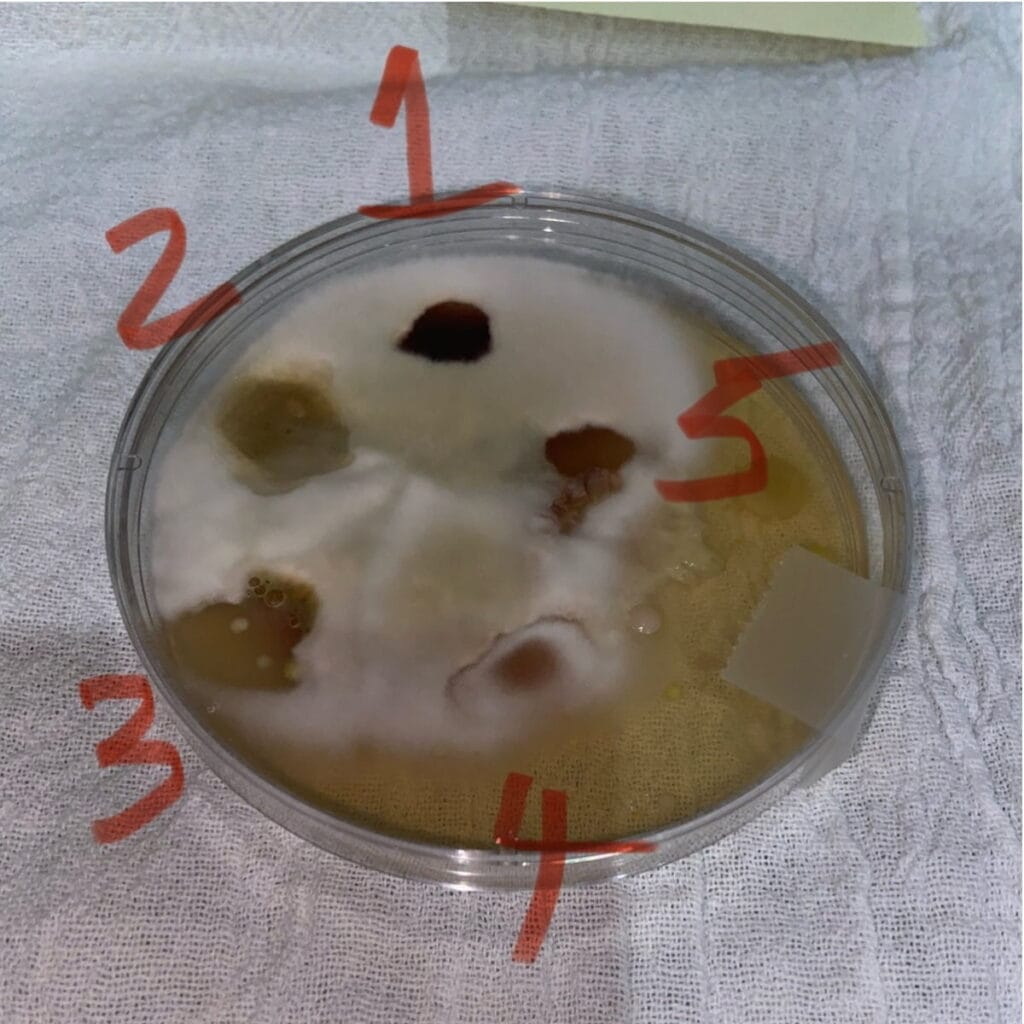
Solution 2 – Lemon slices soaked in vinegar
Solution 3 – DIY cleaning solution – vinegar, water, tea tree oil, and lemon essential oil
Solution 4 – Boulder Clean Disinfectant Cleaner
Solution 5 – Castile soap and water
Experiment 2
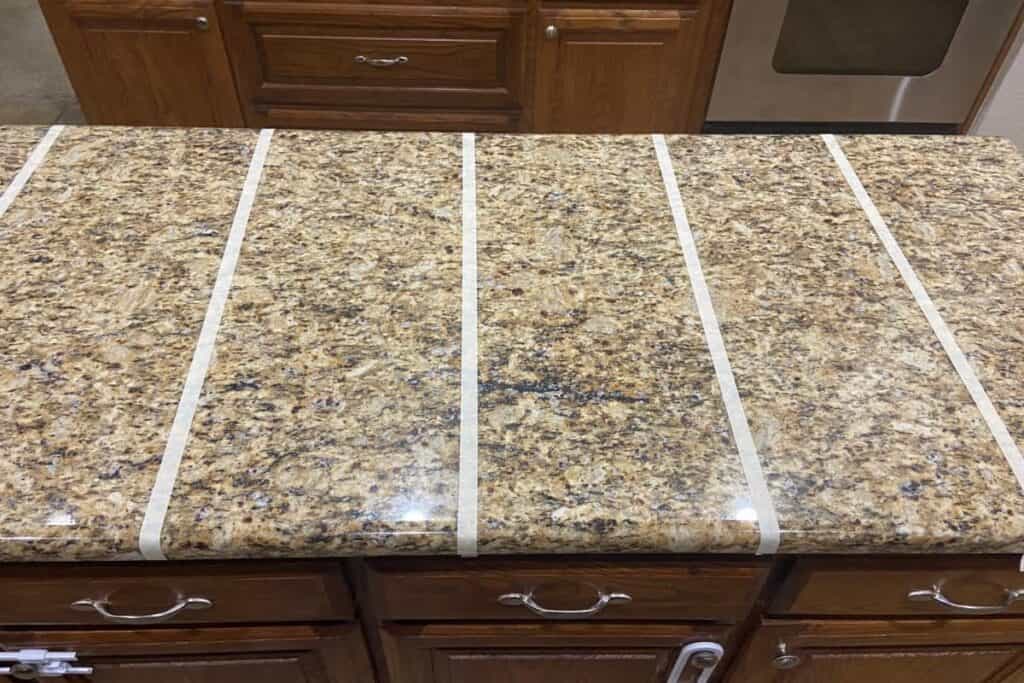
That was interesting, but I also wanted to perform a more readily-applicable experiment. For this, I sectioned off my island into 5 sections using tape. I cleaned each section with one of the cleaners, then swabbed each one to see what would grow. This more closely approximates how we use cleaners — to prevent growth rather that attack established colonies of organisms.
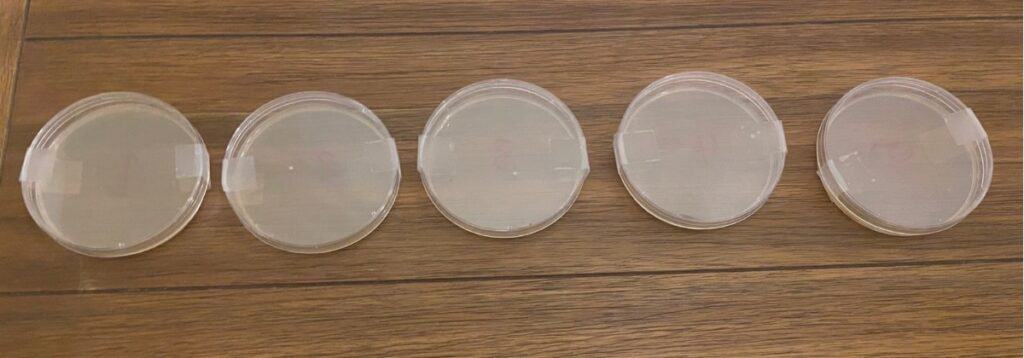
My overall assessment is that all of these cleaning solutions did a satisfactory job preventing growth as it took 5 days for any growth to show up at all. You can see from the picture below that at 5 days, very small colonies of bacteria appeared on plates 2, 3, 4, and 5. This time, bacterial colonies were the main culprit rather than mold. I want to take a moment here to note that bacteria are present pretty much everywhere all the time, so growth is not an indication of failure. Rather, I was impressed the cleaners prevented growth for as long as they did. I did not see substantial growth until 8 days.
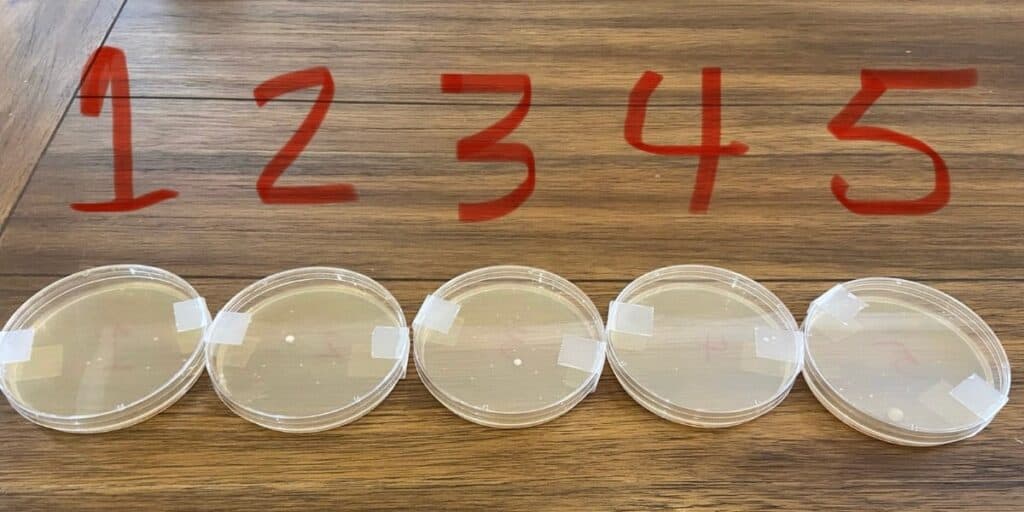
At day 8, there was visible growth on the plates. The most growth seemed to be on plates 2, 3, and 5. This was interesting to me because the two plates that grew the least are the ones with the claim to kill 99.9% of germs. It seems there may be something to the claims!
My Conclusions
So, do natural cleaners work? It does appear that the Formula 409® cleaner and the Boulder Clean disinfectant, both commercial products, prevented bacterial growth the best when looking at the day 8 plates. Based on this experiment alone, I will likely be utilizing Boulder Clean Disinfectant or a similar one such as Sol-U-Guard Botanical® for now. I think these products strike a good balance between having more natural ingredients and also being effective. However, I would like to conduct this experiment again on a dirtier surface, perhaps in a bathroom, to determine if these results hold true.
Stay tuned for further experiments! If you have natural cleaners you would like tested, drop them in the comments!
Leave a Reply